Coverage: Any car, once you have its 17-character VIN
Why can’t you get a window sticker straight from a license plate?
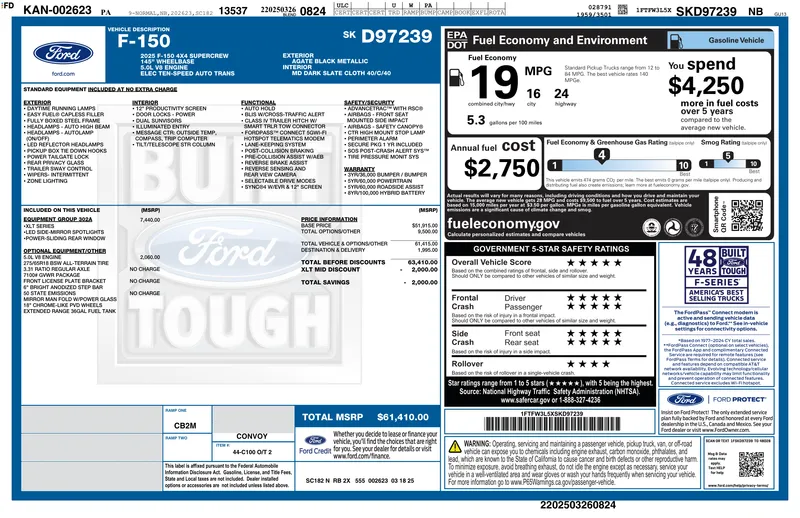
The window sticker, or Monroney label, is printed for one VIN when the car is built. Carmakers, and every sticker service we know of, file it under that VIN. A license plate is a registration issued by a state. It can change when the car is sold, moves to another state or gets vanity plates, and it says nothing about how the car was built.
So a plate lookup always has to go through a VIN first. We’re upfront about that: StickerByVIN looks up by VIN, not by plate. Here’s how to get the VIN legally.
Six legal ways to get the VIN
- Read it through the windshield. Every car sold in the US has the VIN on a small plate at the lower driver’s corner of the dashboard, readable from outside. On a dealer lot or at a private sale, take a photo of it.
- The driver’s door opening. The label on the door jamb repeats the VIN, and usually the build month and paint code too.
- Ask the seller. Dealers almost always put the VIN in the listing. A private seller who wants to sell will give it to you. If they won’t, that tells you something.
- The listing photos. Zoom in on the windshield or the door-jamb photo. Many listings also show the old window sticker, which carries the VIN.
- Your own paperwork, if it’s your car. The registration card, the title, the insurance card and the loan documents all carry the VIN.
- A plate-to-VIN service. Some paid vehicle-history and data companies accept a plate and state and return the VIN with basic vehicle details. It works for many plates, but not all, and you pay for something the windshield gives you for free.
What about privacy?
Looking up a vehicle is one thing. Looking up a person is another. The federal Driver’s Privacy Protection Act (DPPA) restricts who can get personal information, such as names and addresses, from state motor-vehicle records, and only for permitted purposes. Legitimate plate-to-VIN services return vehicle data, not the owner. Be wary of any site that promises an owner’s name from a plate.
We never need or ask for an owner’s details. The VIN alone is enough to find the sticker.
Once you have the VIN
Enter the 17-character VIN in the box above. You’ll get, free:
- the NHTSA decode: year, make, model, trim where it’s coded, engine, drivetrain and assembly plant
- the recall count for that model and year
- whether the original window sticker is on file, before you pay anything
If it is, the $9.99 Full Report gives you the sticker with every option and its price. Whether a sticker exists depends on the brand and year. Ford, Stellantis (Jeep, Ram, Dodge, Chrysler), GM (2022 and later) and Subaru have their own sticker systems, and our licensed partner covers many older GM, Toyota, Hyundai, Genesis, Kia and Nissan VINs. We tested how often each carmaker actually has one in our 84-VIN availability study. For what the label itself shows, see what a Monroney label is.
Last updated November 17, 2026.