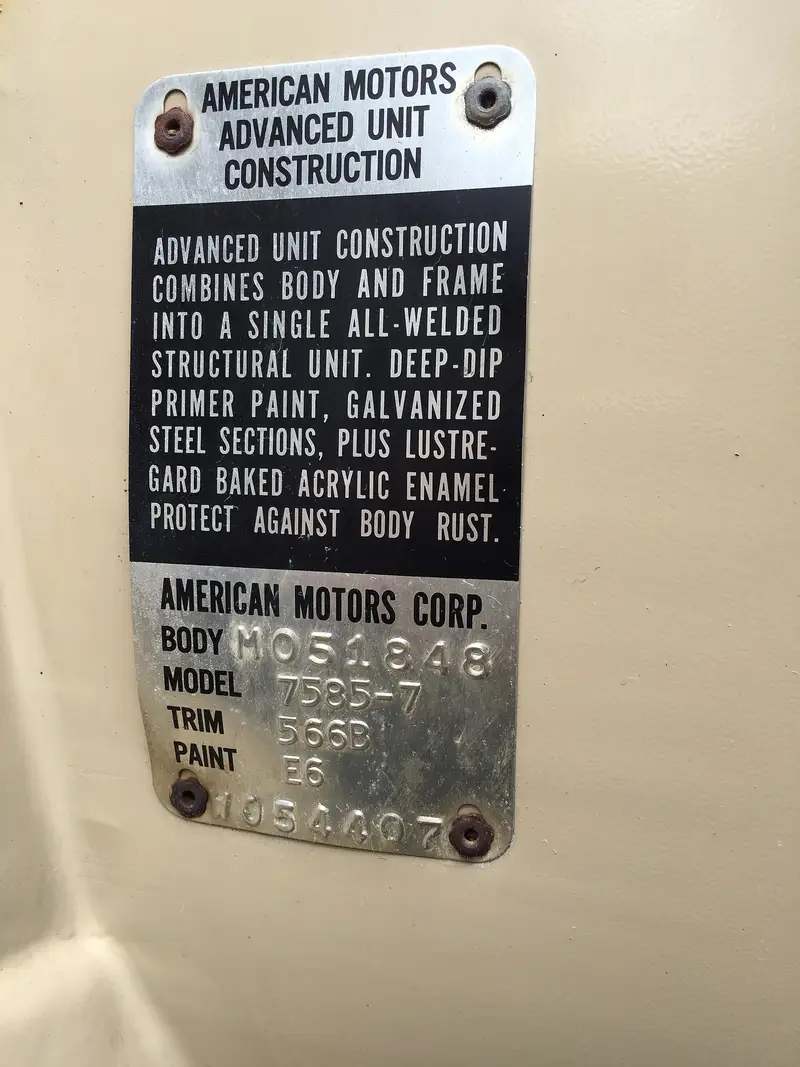
Coverage: Color from the sticker in the Full Report where we have one; free label locations for most modern vehicles
Where is the paint code? Label location by brand
| Brand | Where the label is | What to read |
|---|---|---|
| Ford, Lincoln | Safety Compliance Certification label, on the driver’s door edge or B-pillar | The code after EXT PNT, usually two characters (YZ). Not the “WB” wheelbase figure. |
| Chevrolet, GMC, Buick, Cadillac | Before 2018: SPID label, usually in the glove box. From 2018: certification label on the driver-side B-pillar (Corvette: driver’s door) | A WA or U number (WA8624) on older labels, or a G code (GAZ) printed by the QR code on newer ones |
| Toyota, Lexus | Label in the driver’s door jamb | The first three characters after C/TR (1G3) |
| Honda, Acura | Label in the driver’s door jamb | Letters and digits, sometimes with a dash (NH731P, R513) |
| Jeep, Ram, Dodge, Chrysler | Label in the driver’s door jamb on most modern models. Older models often under the hood. | Three characters next to PAINT, usually starting with P (PW7) |
| Subaru | VIN plate on a front strut tower on older models. Door jamb or door edge on many 2007-and-newer. | Three characters (K1X) |
| Volkswagen | Paper vehicle data sticker in the trunk, usually by the spare-tire well | An L-code and a short code (LC9X/2T) |
| Audi | Paper vehicle data sticker in the trunk, near the spare-wheel well | An L-code and a short code (LY9B/A2) |
| BMW | Driver’s door jamb label on modern BMWs. Driver-side strut-tower plate on classics. | Usually three characters (475, A96) |
| Mercedes-Benz | Driver’s door jamb or B-pillar on most modern models. Under the hood on older cars. | A code such as 197 (Obsidian Black Metallic) |
Most other makers also use a label on the door jamb or pillar. Some put it under the hood or in the trunk, and it varies by model.
A few notes:
- Ford says current exterior codes are two characters, while older vehicles may have more.
- GM added the QR code to Buick, Cadillac, Chevrolet and GMC certification labels from the 2018 model year. GM’s technician publication says the paint code is printed in the lower left of the QR code. On newer GM vehicles with no glove-box label, check the driver-side door jamb and pillar.
- Toyota: on a label reading “C/TR 1G3/FB22”, the paint code is 1G3. The part after the slash is the interior trim code.
- Honda: we don’t have an original-sticker source for Honda, so the label is the best route.
Why the VIN doesn’t contain the paint code
A VIN is 17 characters. It encodes the manufacturer, model line, body and engine details, model year, assembly plant and a serial number. Exterior color is not one of the things it encodes. You can’t decode “red” or “silver” out of the VIN, whatever a website promises.
What you can do is use the VIN to find a record that does include the color:
- The original window sticker. Every Monroney label lists the exterior color by name, and premium paints are often shown as a priced option.
- The manufacturer’s build record, which a dealer can usually pull up from the VIN.
- The paint label on the car itself, which is the most reliable source of the actual code.
What our paint code lookup does
When you enter a VIN:
- We decode it through NHTSA’s free vPIC database to identify the year, make, model and trim.
- If an original sticker is on file, we read the exterior color name from it for the $9.99 Full Report. Ford and Lincoln stickers come from Ford’s own system when Ford has released one. Many other brands come through a licensed data partner.
- We match that color to the factory paint code only when our dataset has a confident match. If not, we show the color name and tell you where the label is on that brand’s vehicles. The label location is free for every VIN.
We’d rather show a color name and point you to the label than give you a guessed code that leads to the wrong touch-up bottle.
How to find your car paint code step by step
- Open the driver’s door and check the door edge and the pillar it closes against. This is the most common spot.
- Check the glove box if it’s a GM vehicle built before the QR-code labels.
- Look in the trunk by the spare-tire well on a Volkswagen or Audi.
- Look under the hood on the radiator support or strut towers if the door jamb label has no color field.
- Read the code next to the color field, such as “EXT PNT”, “C/TR” or “PAINT”. Ignore the VIN, tire pressures and weights on the same label.
- Write down the color name too if you have the sticker. The name and code together help a paint supplier confirm the match.
- Call a dealer with the VIN if the label is missing, faded or was painted over.
Paint code vs color name
The color name on the window sticker, such as “Granite Crystal Metallic Clear-Coat” on one 2020 Jeep Wrangler, is the marketing name. The paint code is the factory’s identifier for the paint formula. Manufacturers sometimes reuse a name for different formulas, or change a code between years, so the code is what you should use for touch-up paint or a body shop.
If you’re checking a used car, comparing the sticker color with the car in front of you is also a quick way to spot a respray. A car sold new in one color and now wearing another isn’t always a problem, but you should ask why.
Related lookups
- Build sheet by VIN for the rest of the factory equipment
- What trim is my car to confirm the trim level
- Window sticker by VIN for the full original sticker where one is available
Sources
- NHTSA vPIC VIN decoder, the free federal database behind our decode
- Ford: What is the paint code for my vehicle?, Ford’s owner support page on EXT PNT
- GM TechLink: QR Code on Certification Label Offers More RPO Codes
- Subaru of America, 2026MY Paint Coding Information (bulletin 13-108-25), hosted by NHTSA
Last updated November 5, 2026.